Alexander the Great, one of history’s most renowned military leaders, dramatically shaped the ancient world through his conquests and vision. This article delves into the life of Alexander, his achievements, and his enduring impact on history.
Early Life and Background
Alexander III of Macedon, commonly known as Alexander the Great, was born on July 356 BCE in Pella, the capital of Macedon. His early life laid the foundation for his future greatness.
- Family: Alexander was the son of King Philip II of Macedon and Queen Olympias. His father was a powerful ruler who unified Macedonia and laid the groundwork for Alexander’s future campaigns. His mother, Olympias, was a fierce and influential figure in Alexander’s life.
- Education: Alexander was tutored by the philosopher Aristotle from a young age. Aristotle instilled in him a love for knowledge and a deep understanding of philosophy, science, and literature, which influenced his later actions and policies.
- Early Military Experience: Alexander began his military career early, leading troops in his father’s campaigns and proving his prowess as a leader. At just 18 years old, he played a key role in the Battle of Chaeronea (338 BCE), which secured Macedonian dominance over Greece.
The Conquests of Alexander
Alexander’s ambition and military genius led to one of the most impressive conquest campaigns in history. His empire stretched from Greece to Egypt and into Asia.
- Ascension to the Throne: After the assassination of his father Philip II in 336 BCE, Alexander ascended to the throne at the age of 20. He quickly consolidated his power and began his campaign of expansion.
- Campaign in Asia Minor: Alexander’s first major campaign was against the Persian Empire, starting with the Battle of Granicus in 334 BCE. This victory opened the door for further conquests into Asia Minor.
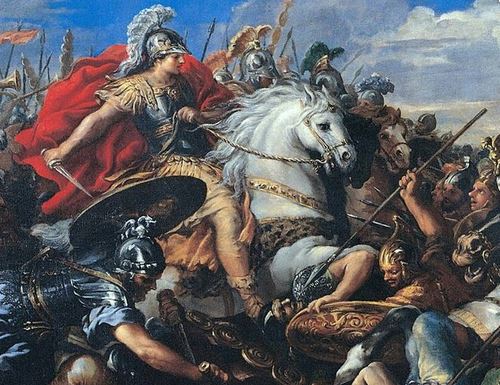
- Battle of Issus: In 333 BCE, Alexander faced the Persian King Darius III at the Battle of Issus. Despite being heavily outnumbered, Alexander’s tactical brilliance led to a decisive victory, cementing his reputation as a formidable military leader.
- Conquest of Egypt: Alexander invaded Egypt in 332 BCE, where he was hailed as a liberator. In Egypt, he founded the city of Alexandria, which became a major cultural and intellectual center of the ancient world.
- Battle of Gaugamela: In 331 BCE, Alexander defeated Darius III once again at the Battle of Gaugamela. This victory effectively ended Persian resistance and secured Alexander’s control over the Persian Empire.
- Campaigns in India: Alexander continued his eastward expansion into India, reaching the Indus River. The Battle of the Hydaspes (326 BCE) against King Porus was notable for its strategic use of cavalry and elephants.
- Return to Babylon: Following his Indian campaign, Alexander’s troops, weary and longing to return home, forced him to turn back. He returned to Babylon, where he began planning further campaigns.
Death and Succession
Alexander’s sudden death in 323 BCE at the age of 32 marked the end of an era and led to a power struggle among his generals.
- Death: Alexander died in the palace of Nebuchadnezzar II in Babylon under mysterious circumstances. The exact cause of his death remains a topic of historical debate, with theories ranging from fever caused by malaria or typhoid to poisoning.
- Division of the Empire: After his death, Alexander’s empire was divided among his generals, known as the Diadochi. The empire eventually fragmented into several Hellenistic kingdoms, including the Ptolemaic dynasty in Egypt, the Seleucid Empire in Asia, and the Antigonid dynasty in Macedonia.
Legacy and Impact
Alexander’s conquests had a profound and lasting impact on the ancient world.
- Hellenistic Culture: Alexander’s empire spread Greek culture and ideas across a vast territory, leading to the Hellenistic Age. This period saw the blending of Greek and Eastern cultures, influencing art, architecture, and science.
- Founding Cities: Alexander founded numerous cities, many of which, like Alexandria, became centers of learning and culture. These cities facilitated the spread of Greek culture and ideas.
- Military Tactics: Alexander’s military strategies and tactics are studied to this day. His use of combined arms, battlefield maneuvering, and psychological warfare became standard practices in military leadership.
- Historical Influence: Alexander’s life and achievements have been the subject of extensive historical study and popular culture. His legend has influenced literature, art, and media throughout history.
Alexander the Great’s Enduring Legacy
Alexander the Great’s extraordinary achievements and vision left an indelible mark on the world. His conquests reshaped the ancient world, spreading Greek culture and establishing new centers of learning and power. Alexander’s life and legacy continue to inspire admiration and study, making him one of history’s most iconic figures.