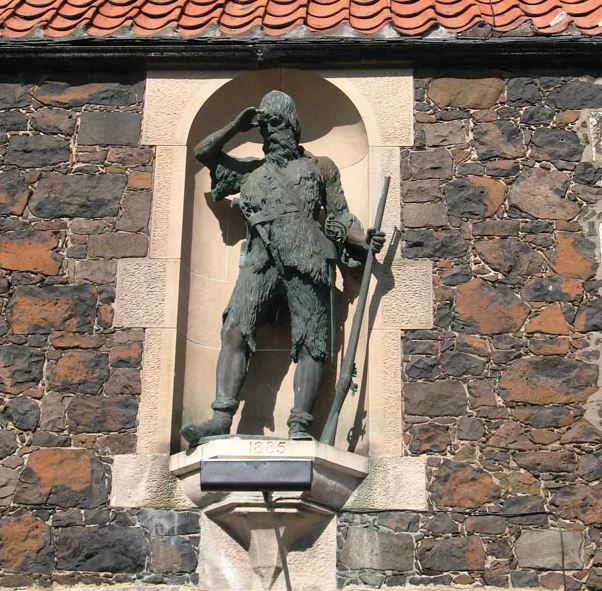
Alexander Selkirk (1676–1721) was a Scottish sailor whose remarkable story of survival on a desert island inspired Daniel Defoe’s famous novel Robinson Crusoe. Selkirk’s experiences offer a fascinating glimpse into maritime adventure and personal endurance in the early 18th century.
Early Life
Born in Lower Largo, Fife, Scotland, on December 26, 1676, Alexander Selkirk grew up in a time when maritime exploration was expanding rapidly. His early life was marked by a strong interest in the sea and adventure, which eventually led him to become a sailor.
The Voyage and Stranding
Early Maritime Career
Selkirk began his maritime career working on privateering voyages, which involved raiding Spanish ships and settlements in the Americas. His experiences on these voyages helped him develop skills that would later prove crucial during his isolation.
The Dispute and Decision
In 1704, during a privateering expedition aboard the ship Cinque Ports, Selkirk had a major disagreement with the ship’s captain. Fearing the ship’s unsafe condition and the possibility of an imminent shipwreck, Selkirk requested to be left on the uninhabited island of Más a Tierra (now known as Robinson Crusoe Island), off the coast of Chile. His request was reluctantly granted, and he was left with minimal supplies.
Life on the Island
Selkirk spent approximately four years and four months on the island, from 1704 to 1709. During this time, he faced numerous challenges:
- Survival Skills: Selkirk used his knowledge of maritime survival skills to adapt to island life. He hunted wild goats, collected shellfish, and utilized his skills to build shelters and tools from available resources.
- Isolation and Health: The isolation took a toll on Selkirk’s mental health. However, his resourcefulness and determination enabled him to survive. He developed a routine that included fishing, foraging, and maintaining his shelter.
- Encounters with Wildlife: Selkirk had to deal with the island’s wildlife, including wild animals and insects. He managed to live in relative comfort by fashioning clothing from animal skins and learning to use local plants for food and medicine.
Rescue and Return to Civilization
In February 1709, after more than four years on the island, Selkirk was rescued by the British privateer ship Duke, commanded by Woodes Rogers, who had been sent on a mission to find Selkirk and other castaways. His return to civilization was marked by:
- Health and Wealth: Selkirk’s return to England brought him into contact with the wealthy and influential. He was celebrated for his survival story and lived comfortably for the remainder of his life.
- Publication of His Story: Selkirk’s tale was widely publicized and became the basis for Defoe’s novel Robinson Crusoe, published in 1719. Defoe’s fictionalized account of Selkirk’s life is one of the most famous survival stories in literary history.
Legacy and Influence
Alexander Selkirk’s story has had a lasting impact on literature and popular culture:
Inspiration for Robinson Crusoe
- Daniel Defoe’s Novel: Selkirk’s experiences were directly referenced in Defoe’s Robinson Crusoe. The novel’s protagonist, Robinson Crusoe, mirrors Selkirk’s survival and adaptation on a desert island. The novel has become a classic in English literature and is considered one of the earliest examples of the survival genre.
Cultural Impact
- Popular Culture: The story of Alexander Selkirk has influenced various forms of media, including books, films, and television shows that explore themes of isolation and survival. His tale continues to captivate audiences and inspire adaptations and retellings.
Alexander Selkirk is remembered for his extraordinary tale of survival and endurance. His real-life experiences on Robinson Crusoe Island provided the inspiration for one of the most enduring stories of individual resilience and adventure. Selkirk’s legacy lives on through the novel Robinson Crusoe and his influence on popular culture, representing the ultimate testament to human perseverance and the spirit of exploration.