

In the nervous system, ANS stands for the autonomic nervous system. It is a part of the peripheral nervous system that controls involuntary bodily functions such as heart rate, digestion, respiratory rate, and blood pressure. The ANS regulates activities that happen without conscious effort.
1. What is the Autonomic Nervous System (ANS)?
Definition:
The autonomic nervous system (ANS) is a critical component of the peripheral nervous system, which regulates involuntary processes that keep the body functioning smoothly. Unlike the somatic nervous system, which governs voluntary movement, the ANS controls automatic bodily functions that are essential for survival, such as breathing, heart rate, and digestion. It operates through a network of neurons that extend from the brain and spinal cord to organs like the heart, lungs, and digestive system(
Primary Functions:
The ANS manages a variety of key physiological processes, including:
- Heart rate: Controls how fast the heart beats based on the body’s needs.
- Digestion: Stimulates or inhibits digestive processes.
- Blood pressure: Regulates the dilation or constriction of blood vessels to control blood pressure.
- Respiratory rate: Adjusts the speed of breathing depending on oxygen demands.
These functions ensure that vital organs and systems work in harmony, responding appropriately to the body’s internal and external conditions(
Importance:
The ANS is crucial for maintaining homeostasis, which is the body’s ability to maintain a stable internal environment despite external changes. By automatically regulating essential functions, the ANS ensures survival and adaptation to various challenges—whether it’s keeping your heart pumping during exercise or calming your systems during rest(
2. Sympathetic Nervous System (SNS)
Overview:
The sympathetic nervous system (SNS) is best known for its role in the “fight or flight” response, a survival mechanism that prepares the body to react to stress or perceived danger. When activated, the SNS triggers a cascade of physiological changes to help you either confront a threat or flee from it(
Function in Stressful Situations:
In times of stress or emergency, the SNS springs into action. It increases heart rate, dilates airways for more oxygen, releases glucose for energy, and redirects blood flow to the muscles needed for physical action. By suppressing non-essential functions like digestion, the body conserves energy and resources to deal with the immediate situation(
Effects on the Body:
- Heart: The SNS raises heart rate, pumping more blood to muscles and vital organs.
- Airways: The bronchi dilate, allowing more oxygen to be inhaled and delivered to the bloodstream.
- Blood Flow: Blood is redirected from the digestive system to muscles, preparing the body for action.
- Digestion: Non-essential functions, like digestion, are temporarily inhibited to conserve energy for immediate survival needs(Medicine LibreTexts)(Cleveland Clinic).
Role in Fight or Flight:
During a threatening situation, the body uses the sympathetic system to prepare for quick action. This mechanism ensures survival by optimizing the body’s physiological responses, providing the necessary energy and focus to either confront the threat or escape from it.
3. Parasympathetic Nervous System (PNS)
Overview:
The parasympathetic nervous system (PNS) is commonly referred to as the “rest and digest” system. It plays a vital role in helping the body relax, recover, and conserve energy following stressful situations. The PNS primarily acts to restore the body to a state of calm, counterbalancing the sympathetic nervous system’s arousal effects.
Function in Relaxation:
When the body is at rest or recovering, the PNS slows down various physiological processes that were heightened during stress. It lowers the heart rate, enhances digestive processes, and promotes energy storage. By doing so, the PNS helps the body conserve energy and return to a balanced state after moments of intense activity or stress.
Effects on the Body:
- Heart: The PNS reduces the heart rate, lowering blood pressure and conserving energy.
- Digestion: It stimulates the digestive system, enhancing the breakdown of food and absorption of nutrients, which is suppressed during sympathetic activation.
- Energy Conservation: By promoting nutrient absorption and storage, the PNS helps the body build reserves for future energy needs.
Role in Homeostasis:
The PNS works in direct opposition to the sympathetic nervous system to maintain homeostasis, the body’s internal balance. While the sympathetic system prepares the body for action, the parasympathetic system helps it recover and restore equilibrium. This dynamic interaction ensures that the body isn’t in a prolonged state of arousal, allowing for both activity and recovery.
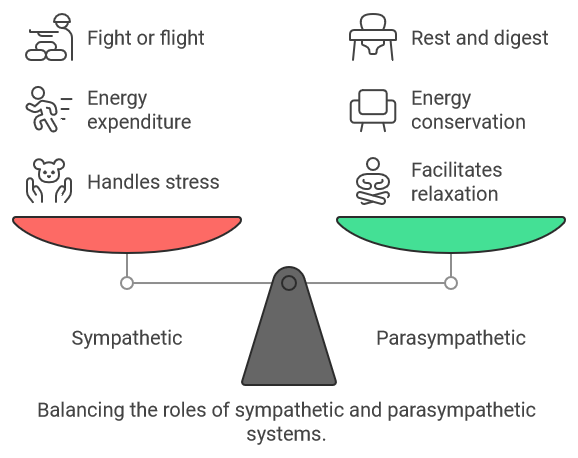
4. Functional Differences Between SNS and PNS
Sympathetic vs. Parasympathetic:
The sympathetic and parasympathetic systems have opposing effects on the body:
- Sympathetic: Handles stress, emergencies, and energy expenditure (fight or flight).
- Parasympathetic: Facilitates relaxation, recovery, and energy conservation (rest and digest).
Dual Innervation:
Many organs receive input from both the sympathetic and parasympathetic systems, a phenomenon called dual innervation. This allows the body to fine-tune responses based on varying situations, balancing the need for action with the need for recovery. For example, the heart can be stimulated by the sympathetic system to beat faster during stress, and then slowed by the parasympathetic system during rest.
5. Neuron Structure in the ANS
Two-Neuron Chain:
The ANS uses a two-neuron chain to communicate with organs:
- Preganglionic neurons: These neurons originate in the central nervous system (CNS) and extend to autonomic ganglia, which act as relay points.
- Postganglionic neurons: These neurons extend from the autonomic ganglia to the target organs, such as the heart or lungs.
Neurotransmitters:
The ANS utilizes specific neurotransmitters to relay signals between neurons:
- Acetylcholine (ACh): Used predominantly in the parasympathetic nervous system to activate responses like reduced heart rate and stimulated digestion.
- Norepinephrine (NE): Primarily used in the sympathetic nervous system to heighten alertness, increase heart rate, and promote energy mobilization.
6. Conclusion
Summary:
The autonomic nervous system is a critical regulator of the body’s involuntary processes, with its two branches—the sympathetic and parasympathetic systems—working in tandem to maintain balance. The sympathetic system prepares the body for stressful situations, while the parasympathetic system allows it to recover and conserve energy, ensuring that physiological functions are optimally regulated.
Closing Thoughts:
The ANS is essential for maintaining the body’s internal stability without requiring conscious thought, enabling us to seamlessly respond to stress and recover from it. Understanding the delicate balance between the sympathetic and parasympathetic systems highlights the complexity of the body’s involuntary regulation, which keeps us alive and functioning effectively.
FAQ
1. What is the autonomic nervous system (ANS)?
The autonomic nervous system is a part of the peripheral nervous system that controls involuntary physiological functions such as heart rate, blood pressure, digestion, and respiratory rate. It operates without conscious control and helps maintain the body’s internal balance, or homeostasis.
2. How does the sympathetic nervous system prepare the body for stressful situations?
The sympathetic nervous system activates the “fight or flight” response during stressful or dangerous situations. It increases heart rate, dilates airways for better oxygen intake, releases glucose for energy, and redirects blood flow to muscles. At the same time, it suppresses non-essential functions like digestion to conserve energy for immediate action.
3. What role does the parasympathetic nervous system play in the body?
The parasympathetic nervous system is responsible for the “rest and digest” functions. It slows down the heart rate, stimulates digestion, and helps the body recover and conserve energy after a stressful event. Its primary role is to promote relaxation and restore balance in the body.
4. How do the sympathetic and parasympathetic systems work together?
These two systems work in opposition to maintain the body’s homeostasis. While the sympathetic nervous system handles stress and emergencies by heightening physiological activity, the parasympathetic nervous system helps the body recover, relax, and conserve energy afterward. Many organs receive input from both systems, ensuring that the body can respond appropriately to different situations.
5. What are the main differences between the sympathetic and parasympathetic systems?
- Sympathetic system: Prepares the body for action in stressful situations (fight or flight).
- Parasympathetic system: Facilitates recovery, relaxation, and energy conservation (rest and digest).
Both systems are part of the autonomic nervous system, but they have opposite effects on organs like the heart, lungs, and digestive system.
6. How are signals transmitted in the autonomic nervous system?
The autonomic nervous system transmits signals through a two-neuron chain. The first, called a preganglionic neuron, originates in the central nervous system and connects to an autonomic ganglion. The second, called a postganglionic neuron, extends from the ganglion to the target organ. The sympathetic system uses norepinephrine as a neurotransmitter, while the parasympathetic system mainly uses acetylcholine.
7. What is the role of neurotransmitters in the ANS?
Neurotransmitters are chemical messengers that transmit signals between neurons. In the sympathetic nervous system, the primary neurotransmitter is norepinephrine (NE), which triggers responses like increased heart rate. In the parasympathetic system, acetylcholine (ACh) is the main neurotransmitter, promoting relaxation and digestion.
8. What happens if the autonomic nervous system malfunctions?
Malfunctions in the ANS can lead to disorders known as dysautonomias, where involuntary functions like blood pressure regulation, heart rate, and digestion are impaired. Symptoms can vary from lightheadedness and abnormal sweating to more severe issues like fainting and difficulty swallowing.


