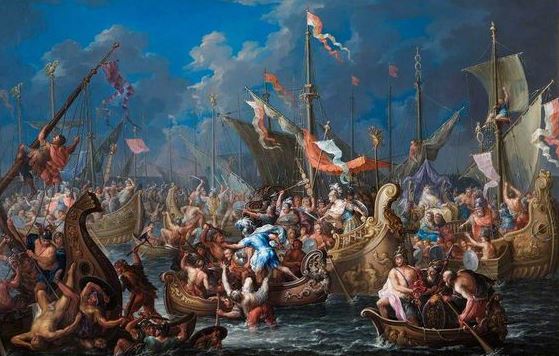
The Battle of Actium, fought on September 2, 31 BCE, was a decisive naval engagement that marked the end of the Roman Republic and the rise of the Roman Empire. This battle was a pivotal moment in Roman history, determining the fate of Rome’s leading figures and reshaping the political landscape of the ancient world.
Historical Context
The Rise of Octavian and Mark Antony
- Octavian (Augustus): Gaius Octavius Thurinus, later known as Augustus, was the adopted heir of Julius Caesar. Following Caesar’s assassination in 44 BCE, Octavian emerged as one of the key figures in the power struggle for control of Rome.
- Mark Antony: A prominent general and ally of Julius Caesar, Mark Antony was a leading figure in Roman politics and military affairs. He formed a political and romantic alliance with Cleopatra VII, the queen of Egypt.
The power struggle between Octavian and Antony was central to the political dynamics of the late Roman Republic. Their conflict was not only political but also personal, with each seeking to consolidate power and control over the Roman world.
The Second Triumvirate
- Formation: In 43 BCE, Octavian, Antony, and Lepidus formed the Second Triumvirate, a political alliance aimed at defeating Caesar’s assassins and stabilizing the Republic. However, the alliance eventually broke down, leading to a power struggle between Octavian and Antony.
- Dissolution: By 33 BCE, tensions between Octavian and Antony had escalated. Antony’s relationship with Cleopatra and his actions in the East were seen as a threat to Octavian’s position and to Rome itself.
The Battle
Strategic and Tactical Overview
- Naval Engagement: The Battle of Actium was a naval confrontation fought in the Ionian Sea near the promontory of Actium in Greece. The battle was characterized by its scale and the strategic use of naval forces.
- Octavian’s Forces: Octavian, supported by his general Agrippa, commanded a fleet of approximately 400 ships. His forces utilized superior naval tactics and were bolstered by their control of key ports and supplies.
- Antony and Cleopatra’s Forces: Antony and Cleopatra commanded a fleet of about 500 ships. Their forces included Egyptian allies and experienced naval crews.
The Course of the Battle
The battle began with Antony and Cleopatra’s fleet attempting to break through Octavian’s lines. Despite their numerical advantage, Antony’s forces were hindered by strategic miscalculations and the superior tactics of Agrippa.
- Turning Point: The turning point of the battle came when Octavian’s forces managed to cut off Antony and Cleopatra’s supply lines and encircle their fleet. The battle became a decisive defeat for Antony and Cleopatra.
- Cleopatra’s Flight: As the battle turned against them, Cleopatra and Antony fled the battlefield, retreating to Alexandria. Their departure marked the collapse of their forces and the beginning of their downfall.
Aftermath and Impact
The Fall of Antony and Cleopatra
- Antony’s Suicide: Following their defeat at Actium, Antony and Cleopatra retreated to Egypt. Facing inevitable defeat, Antony committed suicide in 30 BCE after a failed attempt to rally support.
- Cleopatra’s Death: Cleopatra also chose suicide, marking the end of the Ptolemaic dynasty and Egypt’s status as an independent kingdom.
Octavian’s Ascendancy
- Consolidation of Power: With the defeat of Antony and Cleopatra, Octavian emerged as the uncontested ruler of Rome. He was granted the title of Augustus by the Senate in 27 BCE, marking the official beginning of the Roman Empire and the end of the Roman Republic.
- Augustan Reforms: Augustus implemented a series of reforms that stabilized and centralized the administration of the empire. His reign initiated a period of relative peace and prosperity known as the Pax Romana.
Legacy
The Battle of Actium had profound and lasting effects on the course of Roman history:
- End of the Republic: The victory at Actium and the subsequent rise of Augustus marked the end of the Roman Republic and the beginning of the Roman Empire. This shift fundamentally transformed the political and administrative structures of Rome.
- Historical Significance: The battle has been studied extensively as a key event in Roman history, illustrating the importance of naval power, strategic planning, and political maneuvering in shaping the fate of empires.
- Cultural Impact: Actium has been referenced in various historical and literary works, symbolizing the end of an era and the rise of a new political order.
The Battle of Actium was a pivotal event in the history of Rome, marking the end of the Roman Republic and the beginning of the Roman Empire. The victory of Octavian over Antony and Cleopatra set the stage for a new era of Roman rule under Augustus, shaping the course of Western history for centuries to come.