Find Web Info
  • Home
  • About
  • Privacy Policy
    • Terms of Use
    • Cookies Policy
    • Disclaimer
    • Copyright
  • Blog
    • News
  • Contact Us
Find Web Info
Find Web Info
  • Home
  • About
  • Privacy Policy
    • Terms of Use
    • Cookies Policy
    • Disclaimer
    • Copyright
  • Blog
    • News
  • Contact Us
  • News

Auger Effect Explained: Atomic Insights and Applications

  • May 10, 2026
  • Fernando Filipe
Auger Effect
Total
0
Shares
Total
0
Shares
Share
Tweet
Pin it
Share
Share

The Auger effect reveals intriguing details about atomic interactions. Discovered by French physicist Pierre Auger in 1923, this phenomenon provides key insights into how atoms behave after being excited. Understanding the Auger effect is essential for applications in various fields, from materials science to semiconductor technology.

What is the Auger Effect?

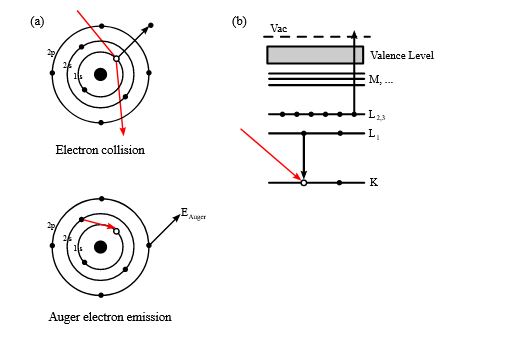
The Auger effect occurs when an atom releases an electron after losing an inner-shell electron. Here’s a simple breakdown of the process:

  1. Initial Ionization: An inner-shell electron is knocked out of the atom by an X-ray photon or another high-energy particle. This creates a vacancy in the inner shell.
  2. Energy Release: An electron from a higher energy level falls into the vacancy. Instead of emitting X-rays, the atom uses this energy to eject a second electron.
  3. Auger Electron Emission: The ejected electron, known as an Auger electron, carries away the energy from the transition.

Key Characteristics

  • Energy Levels: The energy of the Auger electron is specific to the difference between the two electron shells involved in the transition.
  • Analytical Tool: Auger electron spectroscopy (AES) uses the Auger effect to analyze the surface composition of materials. This method provides detailed information about the elements present.
  • Element-Specific: The Auger effect is useful for determining the presence and concentration of elements, making it a powerful tool for surface analysis.

Applications of the Auger Effect

1. Surface Analysis

In materials science, Auger electron spectroscopy (AES) is used to examine the surface composition of various materials, including metals and semiconductors. By analyzing the emitted Auger electrons, scientists can identify the elements on a material’s surface and their concentrations.

2. Semiconductor Research

The Auger effect is crucial for studying semiconductor materials. Researchers use AES to evaluate the quality and composition of semiconductor surfaces, which is essential for developing electronic devices.

3. Thin Film Analysis

AES helps in analyzing thin films and coatings. It provides information about the elemental distribution and thickness, which is important for applications in coating technology and nanomaterials.

Historical Context

Pierre Auger’s discovery of the Auger effect was a milestone in atomic physics. Initially a scientific curiosity, the Auger effect has become an essential tool in many scientific and industrial applications. Advances in spectroscopy and imaging technology have further enhanced its significance in material analysis.

The Auger effect is a vital phenomenon in atomic physics, offering valuable insights into atomic interactions and material surfaces. Its applications in surface analysis, semiconductor research, and thin film evaluation highlight its importance in modern science and technology. By understanding the Auger effect, scientists and engineers can better analyze and develop new materials and technologies.

INTERESTING READ
Alexander VI: The Controversial Pope of the Renaissance
Total
0
Shares
Share 0
Tweet 0
Pin it 0
Fernando Filipe

Fernando Filipe is an expert journalist and the founder of Findwebinfo.com. With a sharp eye for detail and a deep passion for history, he’s dedicated to uncovering the stories that shaped our world. Through clear, engaging writing, he brings the past to life — one fascinating fact at a time.

Previous Article
Aliphatic Compounds
  • News

Aliphatic Compounds: An In-Depth Exploration

  • May 10, 2026
  • Fernando Filipe
View Post
Next Article
Antipope
  • News

Antipope: History’s Pretenders to the Papal Throne

  • May 10, 2026
  • Fernando Filipe
View Post

Leave a Reply Cancel reply

Your email address will not be published. Required fields are marked *

Worth reading

Ægir

Ægir: The Norse God of the Sea

Ægir is a prominent figure in Norse mythology, known as the god of the sea and associated with the primordial...

Alexander I

Alexander I of Russia: The Tsar Who Defeated Napoleon

Alexander I, born on December 23, 1777, in Saint Petersburg, ruled as Emperor of Russia from 1801 to 1825. His...

#CrimeSolvers #WhoWasJackTheRipper #HistoricalMysteries #CrimeDocumentaries #ForensicInvestigation #CrimeTheories #HistoryUncovered #JackTheRipperMystery #AaronKosminski #DNAAnalysis #ColdCase #ForensicScience #TrueCrimeCommunity #UnsolvedMysteries #JackTheRipper #TrueCrime #Mystery #UnsolvedCrimes #LondonHistory #VictorianLondon #SerialKillers

Who Was Jack the Ripper? The DNA Evidence That Points to Aaron Kosminski

Jack the Ripper—the name alone evokes fear, fascination, and endless speculation. This unidentified serial killer terrorized the streets of London’s...

A.E. Housman, born Alfred Edward Housman in 1859, remains one of the most iconic figures in English poetry and classical scholarship.

What is A.E. Housman famous for?

A.E. Housman, born Alfred Edward Housman in 1859, remains one of the most iconic figures in English poetry and classical...

The AIM-7 Sparrow is a radar-guided, air-to-air missile that has been an integral part of various air forces since its introduction in the 1950s.

What is the AIM-7 Sparrow guidance?

Overview of the AIM-7 Sparrow The AIM-7 Sparrow is a radar-guided, air-to-air missile that has been an integral part of...

Amyl alcohol, also known as pentanol, is an organic compound widely used in various industrial and chemical processes.

What is Amyl Alchol?

Amyl alcohol, also known as pentanol, is an organic compound widely used in various industrial and chemical processes. It is...

Find Web Info
  • Home
  • About
  • Privacy Policy
  • Blog
  • Contact Us
© 2025 and beyond Findwebinfo.com

Input your search keywords and press Enter.