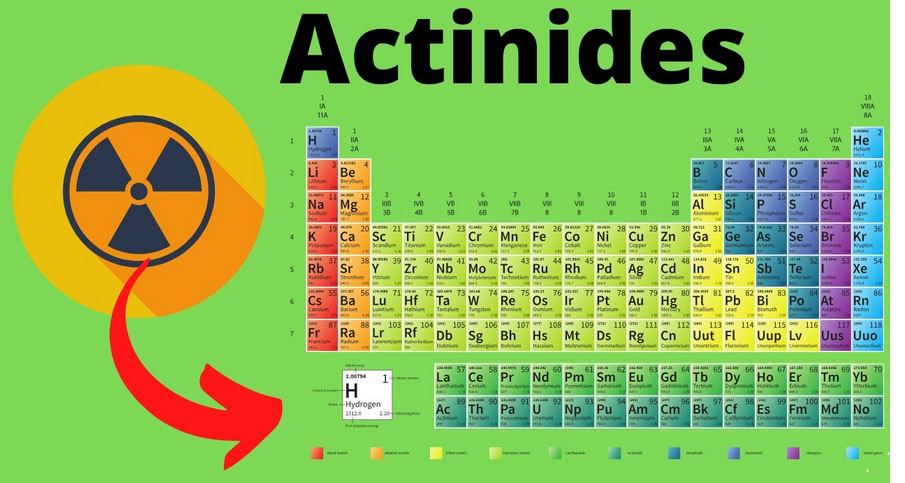
The actinide series, a group of heavy elements in the periodic table, includes some of the most fascinating and complex substances known to science. This article delves into the properties, applications, and significance of the actinide elements, providing a detailed overview of this important group in chemistry.
What Are Actinides?
The actinides are a series of 15 chemical elements with atomic numbers ranging from 89 to 103. They are found in the f-block of the periodic table, following the lanthanides. These elements are characterized by their filling of the 5f electron shell.
- List of Actinides: The actinides include:
- Actinium (Ac, 89)
- Thorium (Th, 90)
- Protactinium (Pa, 91)
- Uranium (U, 92)
- Neptunium (Np, 93)
- Plutonium (Pu, 94)
- Americium (Am, 95)
- Curium (Cm, 96)
- Berkelium (Bk, 97)
- Californium (Cf, 98)
- Einsteinium (Es, 99)
- Fermium (Fm, 100)
- Mendelevium (Md, 101)
- Nobelium (No, 102)
- Lawrencium (Lr, 103)
- Characteristics: Actinides are known for their high density, high atomic weights, and complex electron configurations. They are typically radioactive and exhibit a range of oxidation states.
Properties of Actinides
Actinides possess several unique properties that set them apart from other elements:
- Radioactivity: Most actinides are highly radioactive, with several of them having no stable isotopes. This radioactivity is a result of their large atomic numbers and the instability of their nuclei.
- Physical Properties: Actinides are typically dense metals with high melting points. They have a wide range of colors and are generally shiny or metallic in appearance.
- Chemical Behavior: These elements are known for their diverse chemical behavior. They can form various compounds with different oxidation states, leading to complex chemistry. For example, uranium and plutonium are crucial in nuclear chemistry due to their ability to undergo fission.
Applications of Actinides
The actinides play crucial roles in various fields, particularly in energy and industry:
- Nuclear Power: Uranium and plutonium are key fuels for nuclear reactors. Uranium-235 is used in nuclear fission reactors, while plutonium-239 is utilized in nuclear weapons and reactors.
- Medical Applications: Some actinides, like americium-241, are used in medical devices, such as smoke detectors and certain types of cancer treatments.
- Research: Actinides are important in scientific research, particularly in studying nuclear reactions and radiation. They are used in particle accelerators and experiments to explore fundamental aspects of nuclear physics.
- Environmental Impact: The handling and disposal of radioactive actinides are critical environmental concerns. Safe management of nuclear waste and the prevention of contamination are significant challenges in the use of these elements.
Significance in Chemistry
The actinides are important for several reasons in the field of chemistry:
- Complex Chemistry: The actinides exhibit a wide range of oxidation states and complex chemistry, providing valuable insights into the behavior of heavy elements and their interactions.
- Technological Advances: Research into actinides has led to advancements in nuclear technology and materials science. Understanding their properties and reactions has been essential for developing nuclear energy and weapons.
- Scientific Discovery: The study of actinides has contributed to the discovery of new elements and has enhanced our understanding of atomic structure and nuclear physics.
Challenges and Future Directions
The study and application of actinides come with several challenges and future directions:
- Safety and Waste Management: Managing the radioactive waste produced by actinide elements is a significant challenge. Developing safe disposal methods and containment strategies is crucial for minimizing environmental impact.
- Research: Ongoing research is needed to better understand the properties of actinides and to explore their potential applications in new technologies.
- Sustainability: Finding sustainable and efficient methods for utilizing actinides in nuclear power and other applications is an ongoing area of research.
The actinides represent a group of elements with complex properties and significant applications in science and industry. From their role in nuclear energy to their applications in medicine and research, these elements are crucial for technological advancement and understanding of the natural world. As research continues, the knowledge and management of actinides will play an essential role in addressing future scientific and environmental challenges.