Antiparticles are fundamental components of the universe, crucial to the field of particle physics and our understanding of matter and antimatter. This article delves into what antiparticles are, their properties, and their significance in modern science.
What are Antiparticles?
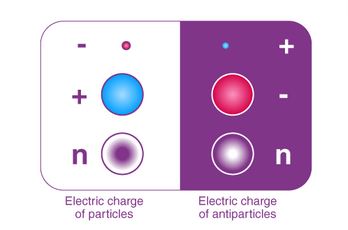
Antiparticles are the counterparts to the particles that make up the matter in our universe. Each particle has a corresponding antiparticle with the same mass but opposite electric charge and other quantum properties.
Key Characteristics:
- Charge Opposites: For every particle with a positive charge, there is an antiparticle with a negative charge. For instance, the antiparticle of the electron (which has a negative charge) is the positron, which has a positive charge.
- Quantum Numbers: Besides charge, antiparticles have opposite values for other quantum numbers like baryon number and lepton number.
- Annihilation: When a particle encounters its antiparticle, they can annihilate each other, converting their mass into energy, usually in the form of photons.
Types of Antiparticles
Different particles have corresponding antiparticles. Here are some examples:
**1. *Electron and Positron:*
- Electron (e⁻): A negatively charged particle found in atoms.
- Positron (e⁺): The positively charged antiparticle of the electron.
**2. *Proton and Antiproton:*
- Proton (p): A positively charged particle in the nucleus of an atom.
- Antiproton (p̅): The negatively charged antiparticle of the proton.
**3. *Neutron and Antineutron:*
- Neutron (n): A neutral particle in the atomic nucleus.
- Antineutron (n̅): The antiparticle of the neutron, which also carries no charge but has opposite quantum numbers.
**4. *Neutrino and Antineutrino:*
- Neutrino (ν): A nearly massless, neutral particle that interacts weakly with matter.
- Antineutrino (ν̅): The antiparticle of the neutrino, with opposite lepton number.
The Role of Antiparticles in Physics
Antiparticles are essential for various reasons in the realm of physics:
**1. *Symmetry and the Standard Model:*
- Antiparticles help in understanding the symmetry of fundamental particles and their interactions. The Standard Model of particle physics incorporates antiparticles to explain the behavior of particles in high-energy environments.
**2. *Antimatter:*
- Antimatter is composed of antiparticles. When antimatter comes into contact with matter, annihilation occurs, releasing energy. This phenomenon has practical implications for technologies such as positron emission tomography (PET) scans in medical imaging.
**3. *Cosmic Ray Studies:*
- Antiparticles are found in cosmic rays and can be studied to gain insights into high-energy processes occurring in space. Research into cosmic rays helps in understanding the origins of these antiparticles and their interactions.
**4. *Fundamental Symmetries:*
- Studying antiparticles contributes to understanding fundamental symmetries in the universe, such as charge-parity (CP) symmetry. Discrepancies in CP symmetry may help explain why the universe is predominantly composed of matter rather than antimatter.
Detection and Applications of Antiparticles
Detecting antiparticles and utilizing their properties has practical and research-based applications:
**1. *Particle Accelerators:*
- Particle accelerators like the Large Hadron Collider (LHC) can create and study antiparticles by smashing particles together at high energies. These experiments help scientists explore the fundamental properties of antiparticles.
**2. *Medical Imaging:*
- Positron Emission Tomography (PET) scans use positrons (antiparticles of electrons) to produce detailed images of the body. This technique is invaluable in diagnosing and monitoring diseases.
**3. *Antimatter Research:*
- Researchers are exploring the potential uses of antimatter in energy production and propulsion. Although practical applications are still in the theoretical or experimental stages, they hold promise for future technologies.
Challenges and Future Directions
**1. *Antimatter Production:*
- Producing and storing antimatter is a significant challenge due to its tendency to annihilate upon contact with matter. Scientists are developing methods to create and contain antimatter for further research.
**2. *Understanding the Matter-Antimatter Asymmetry:*
- One of the major puzzles in physics is why the observable universe is predominantly composed of matter rather than antimatter. Ongoing research aims to uncover why this asymmetry exists and how it influences the universe.
**3. *Applications in Fundamental Physics:*
- Antiparticle studies continue to push the boundaries of our understanding of fundamental physics, contributing to theories beyond the Standard Model and exploring new realms of particle physics.
Antiparticles are a fascinating and crucial aspect of the universe, providing deep insights into the nature of matter and antimatter. From their fundamental roles in particle physics to their practical applications in medical imaging and beyond, understanding antiparticles enhances our comprehension of the cosmos and the fundamental laws governing it. Continued research and exploration of antiparticles hold the potential for groundbreaking discoveries and advancements in science and technology.