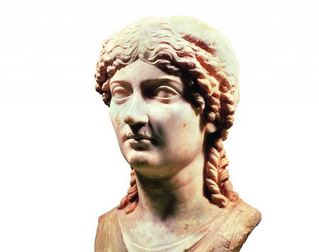
Agrippina the Younger, born in 15 CE, was one of the most powerful and controversial women in ancient Roman history. As the daughter of Agrippina the Elder, the sister of Emperor Caligula, the wife of Emperor Claudius, and the mother of Emperor Nero, her life was intricately linked to the heart of the Roman Empire. Her ambition, political acumen, and influence have made her a figure of enduring fascination.
Early Life and Family Background
Agrippina the Younger was born into the Julio-Claudian dynasty, one of the most powerful and influential families in Roman history. Her father was the famous general Germanicus, and her mother, Agrippina the Elder, was known for her strength and resilience. Agrippina the Younger was the great-granddaughter of Emperor Augustus, which placed her in a position of significant power from birth.
Growing up in the tumultuous environment of the Roman court, Agrippina learned early on the intricacies of political life. Her family’s connections ensured that she was well-educated, preparing her for a life that would see her navigate the complexities of Roman politics with skill and determination.
Marriage to Gnaeus Domitius Ahenobarbus
At the age of 13, Agrippina was married to Gnaeus Domitius Ahenobarbus, a man known for his cruel and arrogant behavior. This marriage produced one son, Lucius Domitius Ahenobarbus, who would later become the infamous Emperor Nero.
Agrippina’s marriage was not a happy one, but it solidified her position within the Roman elite. Her son’s birth was a key moment in her life, as she began to focus her ambitions on securing power for herself and her child.
Return to Power and Marriage to Claudius
Agrippina’s fortunes changed dramatically after the assassination of her brother, Emperor Caligula, in 41 CE. Her uncle, Claudius, became emperor, and Agrippina returned to the political stage. After the death of Claudius’s wife Messalina, Agrippina saw an opportunity to secure her position and married Claudius in 49 CE.
This marriage was controversial due to the close familial ties between Agrippina and Claudius, but it was also a masterstroke of political strategy. As the wife of the emperor, Agrippina wielded considerable influence over Claudius and worked tirelessly to promote her son Nero as his successor.
The Rise of Nero
In 54 CE, Claudius died, possibly poisoned by Agrippina, although the true cause of his death remains a subject of debate. Following Claudius’s death, Nero ascended to the throne at the age of 16, with Agrippina as his regent and the real power behind the throne.
During the early years of Nero’s reign, Agrippina held significant control over the empire. She was a shrewd and capable ruler, using her influence to stabilize the government and manage the affairs of the empire. Her power was reflected in the coins of the period, which depicted her alongside Nero, a rare honor for a Roman woman.
The Decline of Agrippina’s Influence
As Nero grew older, he began to chafe under his mother’s control. Their relationship became increasingly strained as Nero sought to assert his independence. Agrippina’s influence began to wane, and she found herself increasingly marginalized by her son and his advisors.
The final break between mother and son came when Nero became involved with Poppaea Sabina, a woman who despised Agrippina and encouraged Nero to distance himself from his mother. Fearing that Agrippina might try to regain control or even depose him, Nero decided to eliminate her.
Assassination and Legacy
In 59 CE, Nero orchestrated Agrippina’s assassination. According to ancient sources, Nero first attempted to kill her by sabotaging a boat she was on, hoping it would sink. When this plan failed, he resorted to sending assassins to her villa, where they brutally murdered her.
Agrippina’s death marked the end of one of the most powerful women in Roman history. Her life was a complex tapestry of ambition, power, and tragedy. Despite her controversial methods and the dark rumors that surrounded her, Agrippina the Younger’s legacy is one of a woman who broke through the constraints of her time to wield unparalleled influence in the Roman Empire.
Agrippina the Younger remains a compelling figure in history, not only for her connection to some of Rome’s most infamous emperors but also for her own remarkable achievements. Her story is a testament to the power and influence that women could attain in ancient Rome, even in the face of immense challenges. Agrippina’s life, filled with intrigue, ambition, and tragedy, continues to captivate historians and readers alike.