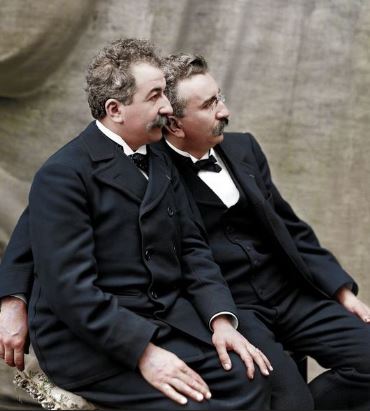
Auguste Lumière (1862–1954) and Louis Lumière (1864–1948) were French inventors and brothers whose pioneering work in the field of cinematography laid the foundation for modern filmmaking. Their innovations in film technology and their public screenings of moving images marked the beginning of cinema as we know it today.
Early Life and Background
1. Family and Early Influences
Auguste and Louis Lumière were born in Besançon, France, into a family of photographers. Their father, Claude Lumière, was a successful photographer and owner of a photo studio. Growing up in a creative environment, the Lumière brothers were exposed to the principles of photography and optical technology from an early age. Their father’s work with photographic equipment and techniques significantly influenced their future inventions.
2. Education and Career Beginnings
Both brothers pursued technical education and worked on various mechanical projects. Auguste studied engineering, while Louis focused on chemistry. Their complementary skills and shared interest in technological innovation set the stage for their future collaborative efforts.
Invention of the Cinematograph
1. Development of the Cinematograph
In 1895, the Lumière brothers developed the cinematograph, a groundbreaking invention that combined the functions of a camera, projector, and printer into a single device. Unlike Thomas Edison’s Kinetoscope, which was a peep-hole viewer for individual use, the Cinematograph was designed for public exhibition, allowing audiences to view moving images on a large screen.
The Cinematograph utilized 35mm film and was lightweight and portable compared to earlier devices. This made it ideal for traveling and public demonstrations, helping to popularize the concept of moving pictures.
2. First Public Screening
On December 28, 1895, the Lumière brothers held their first public screening at the Grand Café in Paris. The event is often considered the birth of cinema. The screening featured a series of short films, including famous clips such as “Workers Leaving the Lumière Factory,” “Arrival of a Train at La Ciotat,” and “The Waterer Watered.” These films showcased everyday scenes and simple movements, capturing the public’s imagination and establishing cinema as a new form of entertainment.
Impact on Cinema
1. Influence on Film Industry
The Lumière brothers’ innovations had a profound impact on the film industry. Their development of the Cinematograph and their public screenings demonstrated the potential of moving pictures as a medium for storytelling and entertainment. The Lumière brothers’ work inspired other inventors and filmmakers, leading to the rapid growth of the film industry and the establishment of cinema as a popular cultural phenomenon.
2. Establishment of Film Techniques
The Lumière brothers’ films were among the first to use basic cinematic techniques, such as framing, editing, and continuity. Their approach to capturing real-life scenes and everyday moments laid the groundwork for documentary filmmaking and narrative cinema. Although their early films were short and simple, they set the stage for the development of more complex and artistic forms of filmmaking.
Later Life and Contributions
1. Auguste Lumière’s Later Work
After their initial success, Auguste Lumière shifted his focus to other scientific and technological pursuits. He worked on various inventions, including improvements to photographic processes and medical imaging techniques. Auguste continued to contribute to the field of photography and film, though he eventually moved away from the cinema industry.
2. Louis Lumière’s Contributions
Louis Lumière remained more actively involved in the film industry for a longer period. He continued to experiment with film techniques and technologies and played a role in promoting the use of film for educational and scientific purposes. Louis was also involved in the early development of color film processes and other innovations in cinematography.
Legacy
1. Recognition and Awards
The Lumière brothers received widespread recognition for their contributions to cinema. Their pioneering work earned them accolades from both the scientific and artistic communities. They are celebrated as key figures in the history of film and are remembered for their role in shaping the medium.
2. Enduring Influence
The legacy of Auguste and Louis Lumière endures in the continued evolution of cinema. Their inventions and ideas laid the groundwork for the development of film as an art form and a means of communication. The Lumière brothers’ influence can be seen in the advancements in film technology, narrative techniques, and the ongoing popularity of cinema as a global cultural phenomenon.
Auguste and Louis Lumière were instrumental in the birth and development of cinema. Their invention of the Cinematograph and their pioneering public screenings marked the beginning of film as a major art form and entertainment medium. Their contributions to the field of cinematography have left an indelible mark on the history of film, and their legacy continues to inspire filmmakers and audiences around the world.