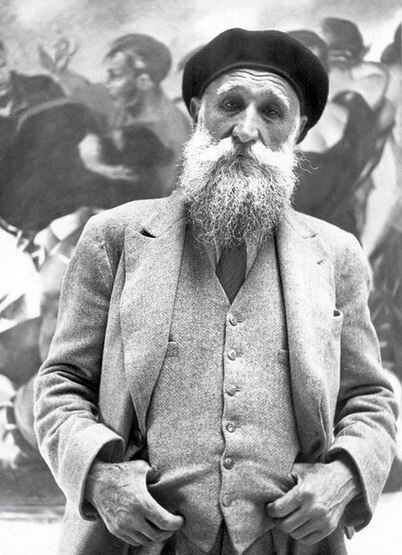
Aristide Maillol (1861–1944) was a French sculptor and painter known for his pioneering work in modern sculpture. His simple, yet powerful, depictions of the human form marked a significant departure from the elaborate, dramatic style of 19th-century sculpture. Maillol’s work is celebrated for its serene, classical qualities and its influence on 20th-century modernism.
Early Life and Artistic Beginnings
1. Birth and Education
Aristide Maillol was born on December 8, 1861, in Banyuls-sur-Mer, a small village in the Roussillon region of southern France. He moved to Paris in 1881 to pursue his artistic ambitions and enrolled in the École des Beaux-Arts, where he studied painting under Jean-Léon Gérôme and Alexandre Cabanel.
While his early work focused on painting and tapestry design, Maillol eventually shifted his attention to sculpture, the medium that would define his career. He was inspired by classical forms and ancient art, which greatly influenced the aesthetic simplicity and purity that became the hallmark of his sculptures.
2. Early Career as a Painter
Before becoming a sculptor, Maillol was an accomplished painter and tapestry designer. He was associated with the Nabis group, a collective of post-Impressionist avant-garde artists that included Pierre Bonnard, Édouard Vuillard, and Maurice Denis. Maillol’s work during this period was largely decorative, focusing on tapestries and other forms of textile art.
However, as his interest in sculpture grew, Maillol began to distance himself from the Nabis group, developing his own unique style.
Transition to Sculpture
1. Influence of Classical Sculpture
By the late 1890s, Maillol had turned his full attention to sculpture, seeking to create works that were simpler and more harmonious than the ornate, emotional styles popular at the time. He was deeply inspired by ancient Greek and Roman sculpture, which emphasized balance, proportion, and idealized human forms.
Maillol’s approach to the human body was distinct from the work of his contemporaries, such as Auguste Rodin, whose sculptures were highly detailed and expressive. Instead, Maillol focused on the purity of form, stripping away excessive detail to emphasize mass, volume, and the flow of lines. His sculptures are characterized by their calm, poised figures, often in relaxed or contemplative poses.
2. Breakthrough Works
One of Maillol’s early major works, “The Mediterranean” (1905), exemplified his style and established him as a major figure in modern sculpture. This piece, a seated female figure, is simple yet monumental, evoking a sense of tranquility and timeless beauty. Unlike Rodin’s dramatic, emotionally charged figures, Maillol’s sculptures radiate calm and balance, emphasizing the abstract beauty of the human form.
“The Mediterranean” marked the beginning of Maillol’s mature style, focusing on serene, sensuous depictions of the female body. The work was well received and heralded as a return to classical ideals in modern sculpture.
Major Themes and Style
1. Simplicity and Serenity
Maillol’s sculptures are known for their focus on the human body, particularly the female form, rendered in smooth, rounded shapes that evoke a sense of peace and stillness. His style is often described as classical and timeless, emphasizing harmony and balance over realism or emotional expression.
In contrast to the dynamism and tension in the works of Rodin and other contemporary sculptors, Maillol’s figures are calm, introspective, and solid. His works frequently depict women in various poses—seated, standing, reclining—yet always maintaining a quiet dignity and grace.
2. Idealization of the Human Form
Maillol’s work reflects his belief in the importance of idealized beauty in art. His sculptures avoid unnecessary details, focusing instead on the essential lines and shapes that define the human body. This approach to form was a precursor to the abstract art movements that would later dominate the 20th century.
3. Sculpture as Architecture
Maillol’s sculptures have often been compared to architecture in their attention to mass and volume. The way he composes the human body, with an emphasis on geometric shapes and solid forms, gives his works a sense of stability and permanence.
Key Works
1. “The Mediterranean” (1905)
This iconic sculpture depicts a seated female figure, resting in a reflective pose. It captures the essence of Maillol’s aesthetic—serene, balanced, and rooted in classical ideals. The simplicity of the form is contrasted by its expressive power, embodying both physical strength and calm introspection.
2. “La Nuit” (Night) (1909)
“La Nuit” is a reclining female figure that continues Maillol’s exploration of the human form. The sculpture’s contours and flowing lines create a sense of peaceful repose, further emphasizing Maillol’s skill at conveying stillness and tranquility through form.
3. “Monument to Cézanne” (1912)
This work, dedicated to the painter Paul Cézanne, exemplifies Maillol’s ability to fuse his reverence for classical art with his personal style. The figure is poised, dignified, and serene, reflecting the same qualities that characterized Cézanne’s approach to art.
4. “Venus” (1928)
In “Venus,” Maillol revisits the classical subject of the goddess of love. The figure is an embodiment of beauty and grace, stripped of unnecessary detail and focused on the purity of form.
Influence and Legacy
1. Impact on Modern Sculpture
Aristide Maillol’s work had a profound influence on the development of modern sculpture. His rejection of excessive detail and emphasis on form over expression laid the foundation for 20th-century movements like modernism and abstraction. His focus on the human body as an idealized form inspired later sculptors, including Constantin Brâncuși and Henry Moore.
2. Contrast with Rodin
Maillol’s approach to sculpture is often contrasted with that of Auguste Rodin, who was the dominant figure in sculpture at the time. While Rodin’s works were emotional and detailed, Maillol favored simplicity and calm, a return to the classical ideals of sculpture. This distinction helped Maillol stand out as a major figure in his own right, offering an alternative vision of modern sculpture.
3. Recognition and Exhibitions
Throughout his career, Maillol gained widespread recognition for his work. His sculptures were exhibited across Europe, and he became one of the most respected sculptors of his time. Today, his works can be found in major museums around the world, including the Musée d’Orsay in Paris and the Museum of Modern Art in New York.
Later Years and Death
In his later years, Maillol continued to work on large-scale sculptures and public commissions. He remained active as an artist well into his seventies. Aristide Maillol passed away in a car accident on September 27, 1944, near his hometown of Banyuls-sur-Mer.
Aristide Maillol was a pioneering figure in modern sculpture, known for his return to classical simplicity and form. His serene, idealized depictions of the human body influenced the direction of 20th-century art, making him a central figure in the transition from traditional to modern sculpture. His legacy endures in the timeless beauty and tranquility of his works, which continue to be celebrated in the world of art.