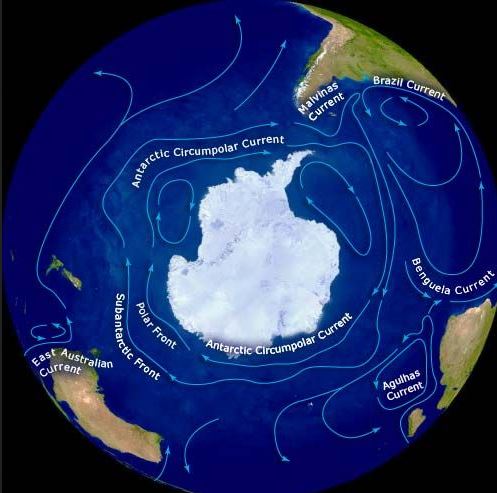
The Antarctic Circumpolar Current (ACC) is the most powerful and largest ocean current on Earth, playing a crucial role in regulating global climate and ocean circulation. It flows continuously from west to east around Antarctica, encircling the continent and connecting the waters of the Atlantic, Pacific, and Indian Oceans.
Key Characteristics
1. Flow and Direction
The ACC flows eastward around Antarctica, driven by strong westerly winds known as the Roaring Forties and Furious Fifties, which blow across the Southern Ocean. It is the only ocean current that flows completely around the globe without being interrupted by landmasses. The ACC extends from the surface to depths of around 4,000 meters (13,000 feet) in some areas, and it transports approximately 135 million cubic meters of water per second—more than any other current in the world.
2. Length and Width
The ACC is over 20,000 kilometers (12,427 miles) long, completely encircling Antarctica. Its width varies between 1,000 and 2,000 kilometers (620 to 1,240 miles), making it a vast and dominant feature of the Southern Ocean.
3. Temperature and Salinity
The ACC transports relatively cold and nutrient-rich water around the continent, which helps to influence marine ecosystems and global climate patterns. The waters within the ACC vary in temperature and salinity depending on depth and geographic location, but it generally helps to mix water masses from different oceans, balancing global salinity and temperature gradients.
Importance and Role in Global Climate
1. Global Ocean Circulation
The ACC plays a critical role in global ocean circulation, serving as a key component of the global thermohaline circulation (also known as the “ocean conveyor belt”). It acts as a barrier that limits the mixing of warmer, subtropical waters with colder polar waters. At the same time, it facilitates the exchange of heat, salt, and nutrients between the world’s oceans, regulating global ocean currents and influencing climate systems.
2. Climate Regulation
The ACC helps regulate Earth’s climate by isolating Antarctica from warmer waters to the north. By maintaining this temperature separation, the ACC helps sustain the Antarctic ice sheets, which play a key role in reflecting solar radiation and regulating global temperatures. The current also affects the transfer of carbon between the ocean and the atmosphere, making it a significant player in Earth’s carbon cycle.
3. Upwelling and Nutrient Distribution
One of the critical features of the ACC is its role in upwelling—the process where deep, nutrient-rich water rises to the surface. This upwelling occurs particularly around the Southern Ocean and fuels the productivity of marine ecosystems by providing nutrients for phytoplankton, the base of the marine food web. The Southern Ocean is one of the most biologically productive areas on the planet due to this nutrient cycling.
Formation and History
The formation of the ACC is closely tied to the tectonic separation of Antarctica from South America and Australia, which occurred around 34 million years ago. This event created the Drake Passage between South America and Antarctica, allowing for the free flow of ocean water around the Antarctic continent. The ACC began to develop shortly after this separation, influencing the cooling of Antarctica and contributing to the formation of the Antarctic ice sheet.
Key Oceanographic Features
1. Fronts of the ACC
The ACC is characterized by several oceanographic “fronts,” or boundaries between different water masses. These include:
- Subantarctic Front (SAF): Separates warmer, saltier subtropical waters from colder subantarctic waters.
- Polar Front (PF): Marks the boundary between subantarctic waters and the cold, dense waters closer to Antarctica.
- Southern ACC Front (SACCF): The southernmost front of the ACC, located close to Antarctica, separating the ACC from the Antarctic Coastal Current.
2. Antarctic Divergence
The ACC is also associated with the Antarctic Divergence, an oceanic region where surface waters move apart, causing upwelling of deeper waters. This process is vital for bringing cold, nutrient-rich water to the surface, supporting marine life in the Southern Ocean.
Impact of Climate Change
The ACC is sensitive to climate change, and shifts in the intensity of westerly winds and ocean temperatures have been observed. As global temperatures rise, changes in wind patterns and sea ice extent may affect the strength and flow of the ACC. This could have far-reaching implications for global ocean circulation, sea-level rise, and marine ecosystems. Additionally, warmer waters could penetrate farther south, potentially destabilizing Antarctic ice shelves and accelerating ice melt.
The Antarctic Circumpolar Current is a critical component of the global climate system and ocean circulation. Its role in regulating temperature, distributing nutrients, and connecting the world’s oceans makes it essential for sustaining marine life and maintaining Earth’s climate balance. As we continue to study and understand the ACC, its future behavior in the face of climate change will be crucial for predicting broader environmental shifts and ensuring the sustainability of our oceans.