Find Web Info
  • Home
  • About
  • Privacy Policy
    • Terms of Use
    • Cookies Policy
    • Disclaimer
    • Copyright
  • Blog
    • News
  • Contact Us
Find Web Info
Find Web Info
  • Home
  • About
  • Privacy Policy
    • Terms of Use
    • Cookies Policy
    • Disclaimer
    • Copyright
  • Blog
    • News
  • Contact Us
  • News

Apollo 10: The Mission That Nearly Landed on the Moon

  • May 30, 2026
  • Fernando Filipe
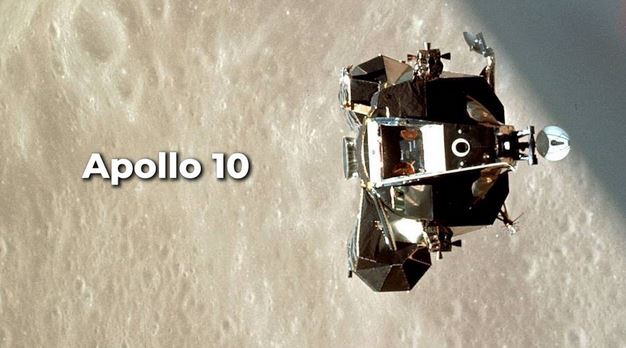
Apollo 10
Total
0
Shares
Total
0
Shares
Share
Tweet
Pin it
Share
Share

Apollo 10 was a significant mission in NASA’s Apollo program, serving as a crucial precursor to the historic Apollo 11 lunar landing. Launched on May 18, 1969, Apollo 10 was a complete rehearsal for the first manned lunar landing, providing essential data and experience for the successful landing that followed.

Mission Overview

1. Objectives

Apollo 10’s primary objectives were to test all the components and procedures for a lunar landing mission without actually landing on the Moon. This included testing the command and service module (CSM), the lunar module (LM), and performing the lunar orbit insertion and descent procedures.

2. Crew

The mission was crewed by three experienced astronauts:

  • Thomas P. Stafford (Commander): A veteran of the Gemini 6A and Apollo 9 missions.
  • John W. Young (Command Module Pilot): Previously flew on Gemini 3 and Gemini 10.
  • Eugene A. Cernan (Lunar Module Pilot): Also a veteran of Gemini 9A and would later command Apollo 17.

Mission Phases

1. Launch and Orbit

Apollo 10 was launched from Kennedy Space Center, Florida, using a Saturn V rocket. The spacecraft entered Earth orbit and was subsequently sent toward the Moon.

2. Lunar Orbit

Upon reaching lunar orbit, Apollo 10 conducted a series of maneuvers to test the lunar module’s performance and its separation from the command module. The mission’s lunar module, designated “Snoopy,” descended to within 15.6 kilometers (9.7 miles) of the Moon’s surface but did not land.

3. Rehearsal and Testing

During its lunar orbit, Apollo 10 performed critical tests, including:

  • Lunar Module Descent: The descent stage of the lunar module was tested, preparing for future landing missions.
  • Communication and Navigation Systems: Ensuring that the equipment and procedures were functioning correctly.
  • Surface and Orbital Parameters: Confirming the data needed for a successful landing.

Key Achievements

1. Precursor to Apollo 11

Apollo 10’s successful mission provided valuable experience and confidence for the Apollo 11 crew, who would land on the Moon just a few months later on July 20, 1969.

2. Testing of Systems

The mission validated the performance of the lunar module and confirmed that all systems were ready for the historic landing. The close approach to the Moon allowed for final adjustments and troubleshooting.

3. Historic Moments

Apollo 10 was notable for being the first mission to have the lunar module complete a full lunar orbit, and it set the stage for the successful Apollo 11 landing.

Post-Mission

1. Return to Earth

After completing its lunar orbit and testing objectives, Apollo 10 re-entered Earth’s atmosphere and landed in the Pacific Ocean on May 26, 1969. The crew was recovered by the USS Princeton.

INTERESTING READ
What is Abertillery famous for?

2. Legacy

Apollo 10 is remembered as a critical stepping stone in the Apollo program. Its successful execution of all mission objectives without landing on the Moon was crucial for the safe and historic Apollo 11 landing.

Apollo 10 was a landmark mission in the history of space exploration. By thoroughly testing all aspects of the lunar landing procedures and equipment, it paved the way for the historic Apollo 11 mission, which achieved the first human landing on the Moon. The mission’s success was a testament to the rigorous preparation and dedication of NASA’s team and laid the groundwork for subsequent lunar exploration.

Total
0
Shares
Share 0
Tweet 0
Pin it 0
Fernando Filipe

Fernando Filipe is an expert journalist and the founder of Findwebinfo.com. With a sharp eye for detail and a deep passion for history, he’s dedicated to uncovering the stories that shaped our world. Through clear, engaging writing, he brings the past to life — one fascinating fact at a time.

Previous Article
Absolute magnitude
  • News

Absolute Magnitude: Understanding Intrinsic Brightness

  • May 30, 2026
  • Fernando Filipe
View Post
Next Article
Abatement of a nuisance refers to the legal and practical steps taken to eliminate or reduce a condition or activity that is harmful or offensive to others.
  • News

What is Abatement of a Nuisance?

  • May 30, 2026
  • Fernando Filipe
View Post

Leave a Reply Cancel reply

Your email address will not be published. Required fields are marked *

Worth reading

Ægir

Ægir: The Norse God of the Sea

Ægir is a prominent figure in Norse mythology, known as the god of the sea and associated with the primordial...

Alexander I

Alexander I of Russia: The Tsar Who Defeated Napoleon

Alexander I, born on December 23, 1777, in Saint Petersburg, ruled as Emperor of Russia from 1801 to 1825. His...

#CrimeSolvers #WhoWasJackTheRipper #HistoricalMysteries #CrimeDocumentaries #ForensicInvestigation #CrimeTheories #HistoryUncovered #JackTheRipperMystery #AaronKosminski #DNAAnalysis #ColdCase #ForensicScience #TrueCrimeCommunity #UnsolvedMysteries #JackTheRipper #TrueCrime #Mystery #UnsolvedCrimes #LondonHistory #VictorianLondon #SerialKillers

Who Was Jack the Ripper? The DNA Evidence That Points to Aaron Kosminski

Jack the Ripper—the name alone evokes fear, fascination, and endless speculation. This unidentified serial killer terrorized the streets of London’s...

A.E. Housman, born Alfred Edward Housman in 1859, remains one of the most iconic figures in English poetry and classical scholarship.

What is A.E. Housman famous for?

A.E. Housman, born Alfred Edward Housman in 1859, remains one of the most iconic figures in English poetry and classical...

The AIM-7 Sparrow is a radar-guided, air-to-air missile that has been an integral part of various air forces since its introduction in the 1950s.

What is the AIM-7 Sparrow guidance?

Overview of the AIM-7 Sparrow The AIM-7 Sparrow is a radar-guided, air-to-air missile that has been an integral part of...

Amyl alcohol, also known as pentanol, is an organic compound widely used in various industrial and chemical processes.

What is Amyl Alchol?

Amyl alcohol, also known as pentanol, is an organic compound widely used in various industrial and chemical processes. It is...

Find Web Info
  • Home
  • About
  • Privacy Policy
  • Blog
  • Contact Us
© 2025 and beyond Findwebinfo.com

Input your search keywords and press Enter.