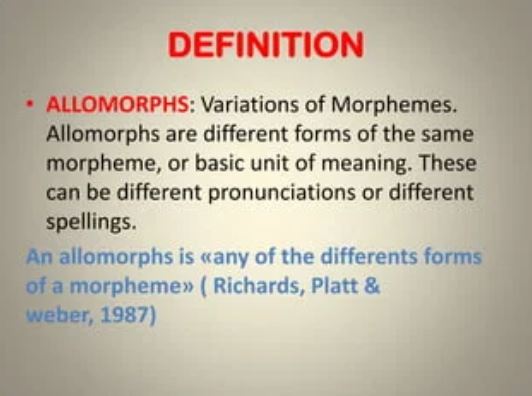
In linguistics, an allomorph refers to one of several variant forms of a morpheme, which is the smallest unit of meaning in a language. Allomorphs occur when a morpheme has different phonetic forms or pronunciations, depending on its phonological or grammatical context. Even though these forms vary, they still convey the same meaning or function.
This article explores the concept of allomorphs, how they function, and provides examples of their use in language.
Definition of Morpheme and Allomorph
- Morpheme: A morpheme is the smallest meaningful unit of language. It can be a root, prefix, or suffix, and cannot be broken down into smaller meaningful parts. For example, in the word “cats”, there are two morphemes: “cat” (the root) and “-s” (a suffix indicating plural).
- Allomorph: An allomorph is a variant form of a morpheme that occurs in different contexts but has the same meaning or grammatical function. The variation can be phonological (based on sound) or orthographic (based on spelling). Even though the form changes, the underlying meaning remains the same.
Types of Allomorphs
Allomorphs can be classified into several types, depending on the reasons for their variation:
1. Phonological Allomorphs
Phonological allomorphs vary depending on the sound environment in which they occur. The choice of allomorph is influenced by the surrounding phonemes (sounds). One of the most common examples is the plural morpheme “-s” in English.
- Plural Allomorphs in English: The plural morpheme in English has three allomorphs:
- /s/ (as in “cats”) – used after voiceless consonants like /t/, /p/, /k/.
- /z/ (as in “dogs”) – used after voiced consonants like /g/, /b/, /d/.
- /ɪz/ (as in “horses”) – used after sibilant sounds like /s/, /z/, /ʃ/, /ʒ/. Despite the different pronunciations, all three forms represent the plural morpheme in English.
2. Morphological Allomorphs
Morphological allomorphs occur due to grammatical or structural changes within the word. This type of variation often happens in the formation of different tenses, genders, or cases.
- Past Tense Allomorphs in English: The past tense morpheme “-ed” also has three allomorphs:
- /t/ (as in “worked”) – used after voiceless consonants like /k/.
- /d/ (as in “played”) – used after voiced consonants like /l/, /b/.
- /ɪd/ (as in “wanted”) – used after /t/ or /d/.
3. Suppletive Allomorphs
Suppletive allomorphs involve cases where a completely different form of a word is used to express a grammatical change. This is a more irregular and unpredictable form of variation.
- Examples of Suppletion:
- Go – went: The past tense form “went” is a suppletive allomorph of the verb “go,” since “went” is not derived from “go” in any regular phonological or morphological way.
- Good – better – best: In the comparison of adjectives, “better” and “best” are suppletive allomorphs of “good.”
Allomorphs in Other Languages
Allomorphy is not unique to English. Other languages also exhibit allomorphs, often with more complex patterns.
1. Spanish Plural Allomorphs
In Spanish, the plural morpheme can take the form of either “-s” or “-es”, depending on the ending of the singular noun.
- “-s”: Used when the noun ends in a vowel (e.g., “gato” → “gatos” for “cats”).
- “-es”: Used when the noun ends in a consonant (e.g., “ciudad” → “ciudades” for “cities”).
2. Arabic Verb Conjugation
In Arabic, verbs undergo changes in their internal structure, leading to different allomorphs depending on the tense, voice, or mood. For example, the root k-t-b (meaning “to write”) takes different vowel patterns to form related meanings:
- kataba: He wrote.
- yaktubu: He writes.
Causes of Allomorphy
Several factors contribute to the existence of allomorphs in a language:
- Phonological Environment: The surrounding sounds influence the pronunciation of a morpheme. For example, the plural morpheme in English adapts to whether the preceding sound is voiced or voiceless.
- Grammatical Requirements: Different forms of a morpheme might be needed to match grammatical categories such as tense, number, or gender.
- Etymology and Historical Development: Some allomorphs arise from historical changes in a language. Suppletive allomorphs, for instance, often reflect the combination of forms from different historical roots.
Importance of Allomorphy
Allomorphy is important in linguistics because it illustrates how morphemes adapt to different linguistic environments while retaining their meaning or function. Understanding allomorphs helps in the study of:
- Morphological analysis: The structure of words and how they change in different contexts.
- Phonology: The study of how sounds interact within a language.
- Language learning: Recognizing allomorphs can aid learners in understanding the rules behind irregular word forms.
Allomorphs play a crucial role in the morphological structure of languages, offering insight into how words change in form depending on their phonological or grammatical context. Whether through predictable patterns, like English plural endings, or through irregular forms, such as in suppletion, allomorphs showcase the flexibility and complexity of language. Understanding allomorphy helps linguists decode the rules that govern word formation and language evolution.