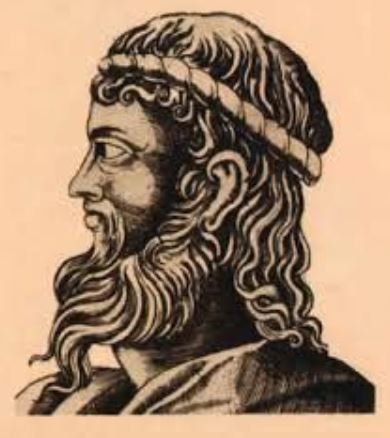
Anaximenes of Miletus (c. 585 – c. 528 BCE) was a pre-Socratic Greek philosopher and a key figure in the Milesian School, a group of thinkers who sought to explain the nature of the universe through natural causes rather than mythology. As a student and follower of Anaximander and a contemporary of Thales, Anaximenes is remembered for his unique cosmological theory that proposed air as the fundamental substance underlying all existence.
This article explores the life, philosophy, and impact of Anaximenes, examining his theories on the nature of reality, the processes of change, and his influence on later philosophical thought.
Early Life and Background
Anaximenes was born in Miletus, an ancient city in Ionia (modern-day Turkey), a region that was a hub of intellectual activity during the 6th century BCE. Miletus, as a center of trade and culture, attracted thinkers and travelers from across the Greek world. Anaximenes was part of the Milesian School, following in the footsteps of Thales and Anaximander, who sought to explain the universe in terms of a single, fundamental element.
While little is known about Anaximenes’ personal life, his intellectual contributions stand out, especially for his ideas regarding the nature of the cosmos and the processes that govern change in the natural world.
Anaximenes’ Cosmology: Air as the Arche
Anaximenes’ most famous philosophical contribution was his assertion that air is the arche—the primary substance or principle from which everything in the universe originates. This idea was a continuation of the Milesian School’s tradition of monism, the belief that a single, underlying substance gives rise to all things.
For Anaximenes, air was the source of all matter, and he believed that different forms of matter could be explained by the processes of rarefaction and condensation. According to his theory:
- Rarefaction (the expansion of air) leads to the formation of lighter elements like fire.
- Condensation (the compression of air) results in denser forms, such as wind, clouds, water, and eventually earth and stone.
Anaximenes saw air as a dynamic, life-giving substance that could take on different forms, providing an elegant explanation for the diversity of objects and phenomena in the world.
Anaximenes’ Explanation of Change
Anaximenes’ concept of change was rooted in his understanding of air’s transformation through rarefaction and condensation. He proposed that everything in the universe is in a state of flux, constantly shifting from one form to another. This process allowed him to explain natural events such as:
- The formation of clouds and rain (from the condensation of air).
- The generation of wind (from the movement of condensed air).
- The creation of fire (from the rarefaction of air).
By framing change as a natural and continuous process, Anaximenes moved away from supernatural explanations and provided a model that sought to understand nature through observation and reason.
The Role of Air in Life and the Soul
For Anaximenes, air was not just the substance from which physical matter emerged, but also the principle of life. He believed that air was the breath of life—what the Greeks referred to as pneuma. He saw a direct connection between air and the soul, equating the movement of air with the breath that sustains living beings.
Anaximenes viewed the cosmos itself as a living organism, with air as its animating force. This idea suggested that just as air sustains human life, it also sustains the universe as a whole, imbuing it with motion and vitality.
Comparison with Anaximander and Thales
Anaximenes’ ideas represented a development of the work of his predecessors, Thales and Anaximander:
- Thales (considered the founder of natural philosophy) believed that water was the fundamental substance of the universe.
- Anaximander introduced the concept of the apeiron (the boundless or infinite) as the source of all things, a more abstract principle than the elements proposed by Thales or Anaximenes.
In contrast to the apeiron, which was indefinite and difficult to conceptualize, Anaximenes offered air as a more tangible and observable arche. His emphasis on air as a physical substance allowed him to explain natural processes in a way that was accessible and logical, continuing the shift toward understanding the universe in terms of natural causes.
Anaximenes’ View of the Cosmos
Anaximenes also contributed to early cosmology with his theory of the shape of the earth and the nature of the heavens. He believed that the earth was flat and floated on a cushion of air, a common view in ancient Greek cosmology. In his model, air not only supported the earth but also played a crucial role in sustaining the celestial bodies.
He viewed the sun, moon, and stars as being made of fire, with their heat being generated by the rarefaction of air. According to Anaximenes, these heavenly bodies circled around the earth, suspended in air like leaves being carried by the wind.
Influence and Legacy of Anaximenes
Anaximenes’ contributions had a significant impact on later philosophers, especially those who sought to understand the natural world through observation and reason rather than mythology. His work, though overshadowed by figures like Heraclitus and Parmenides, was crucial in advancing early Greek natural philosophy.
Influence on Later Thinkers
Anaximenes’ ideas about air and transformation influenced later pre-Socratic philosophers, such as Heraclitus, who also believed in the continuous flux of matter. His emphasis on a natural explanation for change also laid the groundwork for Empedocles, Anaxagoras, and the Atomists, who would continue exploring how different elements and forces interact to create the natural world.
Scientific and Philosophical Contributions
Though much of Anaximenes’ work has been lost, his legacy endures in the history of scientific thought. His approach to explaining natural phenomena based on observable processes was a precursor to later scientific inquiry. His ideas on condensation and rarefaction offered an early model of how substances change form, an important concept in the development of both physics and chemistry.
Anaximenes of Miletus was a pioneering philosopher who made significant contributions to early Greek thought by proposing air as the fundamental substance of the universe. His belief that all matter arises from the rarefaction and condensation of air offered a logical, natural explanation for the diversity of objects and phenomena in the world. By continuing the Milesian tradition of seeking natural causes for cosmic events, Anaximenes helped shape the foundations of Western philosophy and science.
His work laid the groundwork for future generations of thinkers who would explore the nature of the universe, and his innovative ideas about the processes of change and transformation remain an essential part of the history of philosophy.