In philosophy, understanding how we acquire knowledge is crucial. Two fundamental concepts in this discussion are a priori and a posteriori knowledge. These terms help distinguish between different ways we come to know and understand the world. This article explores what these concepts mean, how they differ, and their significance in philosophy.
What is A Priori Knowledge?
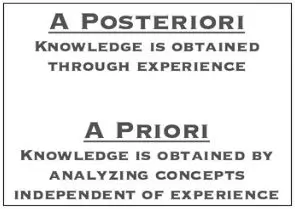
A priori knowledge refers to knowledge that is independent of experience. This type of knowledge is acquired through reasoning and logical deduction rather than sensory experience.
- Definition and Characteristics: A priori knowledge is typically considered to be self-evident and universally true. For example, mathematical truths and logical principles fall into this category. The statement “2 + 2 = 4” is known a priori because it can be understood through pure reasoning without needing to count physical objects.
- Examples in Philosophy: Philosophers like Immanuel Kant have argued that certain types of knowledge, such as mathematical truths and principles of logic, are a priori. Kant claimed that these types of knowledge are necessary for making sense of our experiences and understanding the world.
- Significance: A priori knowledge is crucial because it forms the foundation upon which other types of knowledge are built. For instance, understanding basic principles of logic and mathematics allows us to make sense of empirical data and scientific observations.
What is A Posteriori Knowledge?
A posteriori knowledge, on the other hand, is knowledge that depends on empirical evidence or sensory experience. This type of knowledge is gained through observation, experimentation, and experience.
- Definition and Characteristics: A posteriori knowledge is based on what we can observe or experience in the world around us. For instance, knowing that it is raining outside because you see raindrops or feel wetness is a posteriori knowledge. This knowledge is not universally true but is contingent upon sensory experiences.
- Examples in Philosophy: In contrast to a priori knowledge, a posteriori knowledge involves empirical evidence. The statement “The sky is blue today” is an example of a posteriori knowledge because it is based on direct observation.
- Significance: A posteriori knowledge is essential for empirical sciences, which rely on observation and experimentation to understand natural phenomena. This type of knowledge helps us build theories and models based on real-world data.
Differences Between A Priori and A Posteriori Knowledge
Understanding the differences between a priori and a posteriori knowledge is crucial for grasping their roles in philosophy and science.
- Source of Knowledge: A priori knowledge comes from reasoning and logical deduction, while a posteriori knowledge comes from sensory experiences and empirical observation.
- Universality: A priori knowledge is often seen as universally true and necessary, whereas a posteriori knowledge is contingent upon specific experiences and observations.
- Examples: Mathematical truths (a priori) vs. weather observations (a posteriori). For example, “All bachelors are unmarried” is a priori knowledge, while “It is currently raining” is a posteriori.
Philosophical Implications
The distinction between a priori and a posteriori knowledge has significant implications for various areas of philosophy, including epistemology (the study of knowledge), metaphysics (the study of reality), and the philosophy of science.
- Epistemology: The study of how we come to know things often involves examining the roles of a priori and a posteriori knowledge. Epistemologists debate whether certain types of knowledge are purely a priori or if all knowledge ultimately relies on experience.
- Metaphysics: Philosophers also explore how a priori and a posteriori knowledge contribute to our understanding of reality. For instance, questions about the nature of space, time, and existence often involve considerations of both types of knowledge.
- Philosophy of Science: The philosophy of science examines how scientific knowledge is derived and validated. This includes discussions about the role of empirical evidence (a posteriori) and theoretical frameworks (a priori) in scientific inquiry.
In summary, a priori and a posteriori knowledge represent two fundamental ways of acquiring and understanding knowledge. A priori knowledge is gained through reasoning and logical deduction, while a posteriori knowledge is derived from sensory experience and empirical observation. Both types of knowledge play crucial roles in philosophy and science, shaping our understanding of the world and the methods we use to acquire knowledge.
By distinguishing between these two types of knowledge, we gain insight into the nature of our beliefs and the processes by which we come to know and understand the world around us. Whether through abstract reasoning or empirical observation, both a priori and a posteriori knowledge are essential components of human cognition and inquiry.